Description
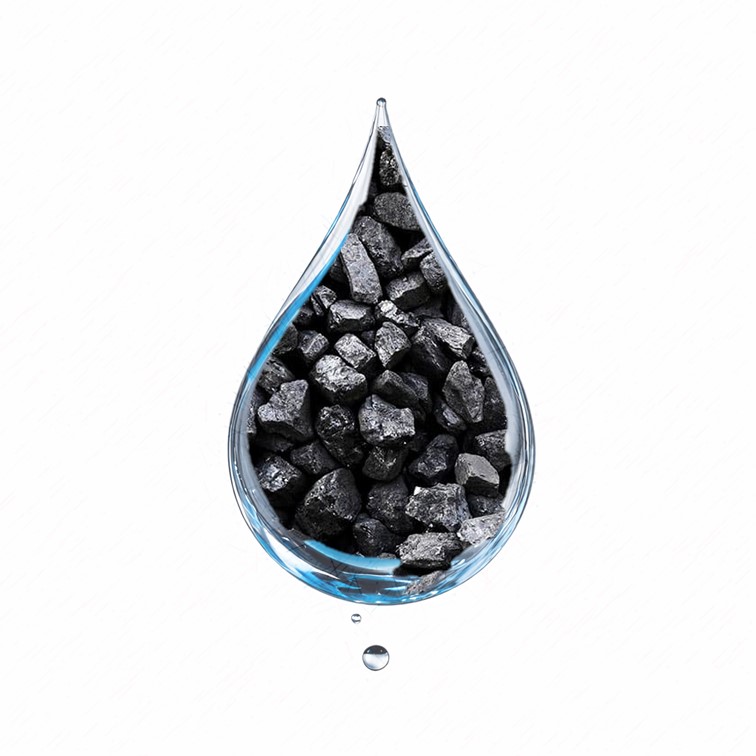
Anthracite is a type of hard, high-carbon coal that is commonly used in water treatment systems as a filter media. It plays an important role in mechanical filtration and is especially effective in removing suspended solids from water.
🔹 What is Anthracite?
-
A naturally occurring form of coal with a high carbon content (around 86–98%)
-
Very hard and brittle
-
Has a high specific gravity and durability
-
Chemically inert and non-toxic
🔹 Role of Anthracite in Water Treatment:
| Function | Explanation |
|---|---|
| Filtration | Removes turbidity, suspended solids, and organic matter |
| Multimedia Filters | Often used as the top layer in multimedia filters, above sand and garnet |
| Depth Filtration | Allows water to flow through deeper layers before reaching finer media, improving filtration capacity |
| Backwash Efficiency | Lightweight compared to sand, making backwashing easier and more efficient |
🔹 Benefits of Using Anthracite:
-
High dirt-holding capacity
-
Long service life
-
Improves filter run time
-
Resistant to biological and chemical fouling
-
Cost-effective for large-scale filtration
🔹 Common Applications:
-
Municipal drinking water plants
-
Industrial process water
-
Wastewater treatment
-
Pretreatment for RO systems
-
Swimming pool filtration
🔹 Specifications (Typical):
-
Effective size: 0.6 – 1.6 mm (can vary)
-
Uniformity coefficient (UC): <1.7
-
Specific gravity: ~1.5
-
Hardness (Mohs scale): ~3
Anthracite is commonly used in pressure and gravity filtration systems, especially as part of multimedia filters in both industrial and municipal water treatment setups.
Here’s a breakdown of filtration systems that use anthracite:
🔹 1. Multimedia Filters (MMF) / Dual Media Filters
Usage:
✔️ Most common system using anthracite
✔️ Used for potable, process, and wastewaterDescription:
Multimedia filters consist of layers of different media with varying densities and sizes. Anthracite, being the least dense, is used as the top layer to capture coarse particles, while finer media like sand or garnet below capture smaller particles.Typical Media Configuration (top to bottom):
-
Anthracite (coarse filtration)
-
Sand (intermediate filtration)
-
Garnet (fine filtration)
Benefits:
-
Improved filtration depth
-
Longer filter runs
-
Better particle removal than single-media filters
🔹 2. Gravity Sand Filters (e.g., in Water Treatment Plants)
Usage:
✔️ Municipal drinking water plants
✔️ Slow or rapid gravity filtersDescription:
Anthracite may be added as a coarse media layer to increase filtration capacity and reduce clogging. It is especially used in rapid gravity filters for high-flow applications.
🔹 3. Pressure Filters
Usage:
✔️ Industrial water treatment
✔️ Cooling tower water systems
✔️ RO pretreatmentDescription:
Closed vessels where water is forced through media under pressure. Anthracite is used to remove suspended solids, protecting downstream systems like membranes or ion exchange units.
🔹 4. Tertiary and Polishing Filters
Usage:
✔️ Wastewater polishing
✔️ Final filtration stage before discharge or reuseDescription:
Anthracite helps in the final removal of fine particles, organics, and some trace metals when used with other media.
🔹 5. Desalination Pretreatment Systems
Usage:
✔️ RO/NF/UF system pretreatment
✔️ Seawater or brackish water treatmentPurpose:
Reduce fouling on membranes by filtering out suspended solids, organics, and particulates using anthracite in MMF configurations.
🔹 Summary Table:
System Type Role of Anthracite Industry Use Multimedia Filters Coarse filtration (top layer) Municipal, industrial, commercial Gravity Sand Filters Coarse pre-filtration Municipal water treatment Pressure Filters Suspended solids removal Process water, cooling towers Polishing Filters Final fine filtration Wastewater reuse RO Pretreatment Membrane protection Desalination, pharmaceutical, food -

Reviews
There are no reviews yet.