
UV Ballast ET-24 230V/50hz 65-85W
🔌 1. WHAT IS A UV TRANSFORMER?
A transformer only changes voltage.
It does NOT control the lamp, frequency, ignition, or current.
✔ What it does:
-
Steps 220V → lower voltage (e.g., 110V, 24V, 12V)
-
Supplies basic power
-
Used in old UV systems or small simple Chinese units
❌ What it cannot do:
-
Cannot ignite a UV lamp properly
-
Cannot regulate lamp current
-
Cannot protect the lamp from overloading
-
Cannot keep frequency stable
-
Cannot compensate when the lamp heats up
🔥 Result:
Transformers often cause:
-
Lamps to burst
-
Quartz sleeves to crack
-
Lamps to flicker or not start
-
Shorter lamp lifespan
⚡ 2. WHAT IS A UV BALLAST?
A ballast is an intelligent power controller designed specifically for UV lamps.
✔ What it does:
-
Ignites the UV lamp correctly
-
Controls current flow
-
Maintains stable frequency (40–60 kHz)
-
Prevents overheating
-
Extends UV lamp lifespan
-
Provides stable UV intensity
-
Works with quartz sleeve thermal conditions
✔ Modern units use Electronic Ballasts (EB)
These are small, compact boxes that:
-
Start the lamp quickly
-
Run it efficiently
-
Protect against over-voltage and over-current
-
Are used in high-quality UV systems
🆚 TRANSFORMER VS BALLAST (Simple Table)
| Feature | Transformer | Electronic Ballast |
|---|---|---|
| Controls voltage | ✅ Yes | ✅ Yes |
| Controls current | ❌ No | ✅ Yes |
| Starts UV lamp correctly | ❌ No | ✅ Yes |
| Prevents lamp flicker | ❌ No | ✅ Yes |
| Prevents lamp burst | ❌ No | ✅ Yes |
| Protects electronics | ❌ No | ✅ Yes |
| Used in | Old cheap UV systems | Modern UV sterilizers |
| Safe with quartz sleeve | ⚠ Risky | ✅ Safe |
| Lamp lifespan | Short | Long |
👀 HOW TO TELL THE DIFFERENCE PHYSICALLY
🔻 Transformer (old type)
-
Big, heavy, block-shaped
-
Mostly iron core
-
Gets hot
-
Only 2 or 3 wires coming out
-
No labels about Hz, frequency, or ignition
🔹 Ballast (modern UV)
-
Smaller, compact box
-
Lightweight
-
Many wires (4–6)
-
Markings: “Electronic Ballast”, “40kHz”, “Start current”
-
Sometimes has indicator LEDs
Description
🔎 Visual Comparison: Transformer / Magnetic vs Electronic Ballast for UV
Transformer / Magnetic-type ballast (or “old style”)


How it looks / key features:
-
Typically a large, heavy metal box (often with an iron core if magnetic) or bulky housing.
-
Fewer wires — often just input (mains) and output to the lamp.
-
Often labeled simply “transformer” or “ballast / choke,” sometimes without modern electronics marks.
-
Older style: heavier, larger, sometimes hot to the touch during operation.
⚠️ This type only changes voltage or offers very basic current limiting, but does not precisely control lamp ignition or optimize lamp current & frequency.
Because of that, with modern UV-C lamps the old-type ballast or transformer often leads to instability, flicker, poor UV output, or even lamp damage.
Electronic Ballast / Lamp-Driver (Modern UV systems)

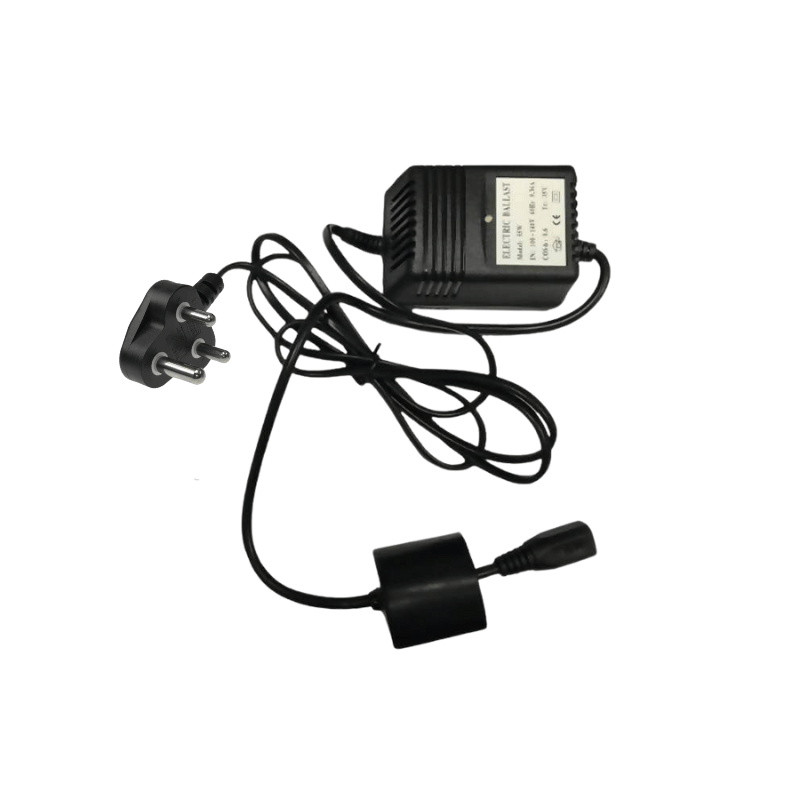

How it looks / key features:
-
Usually a compact, lightweight rectangular / box-type module (often aluminium or plastic shell).
-
Multiple wires/wire harness (input mains and multiple output wires) — especially for 4-pin or multi-lamp setups.
-
Marked as “ballast”, “lamp driver”, possibly with specs (voltage range 110–240 V, lamp wattage, frequency, safety markings).
-
Modern design — more compact, cooler, efficient, sometimes with LED indicators.
✅ What it does better: starts the UV lamp correctly, regulates current, maintains stable high-frequency output (often 20–70 kHz) so the lamp runs stable and at correct intensity, which gives higher UV output, longer lamp life, less flicker / electrode stress.
Electronic ballasts have largely replaced old transformer/magnetic style for modern UV-C water sterilization systems.
🧠 What the Images + Comparison Tell You (for Your Work)
-
If your UV system uses a big heavy metal box with few wires, it’s likely a transformer / magnetic ballast — a “basic” power supply.
-
If it uses a compact module with multiple wires, labelled for lamp wattage / voltage / frequency, that’s a modern electronic ballast / lamp driver — the preferable choice.
-
Using an electronic ballast greatly reduces risk of lamp bursts / failures, ensures stable UV output, protects your quartz sleeve and extends lamp and system lifespan.

Reviews
There are no reviews yet.